AI is pushing creative professionals to the end of the image chain
Survey of illustrators: 46 per cent have lost work to generative AI
Almost half of the illustrators who took part in the new survey by the UK's Association of Illustrators (AOI) know of commissions that went to generative AI instead. But the report “AI and the Future of Illustration” (Click here to download) shows more than lost jobs: even where people are still being hired, AI images are changing briefs, fees and the role creatives play in the process. Austrian illustrator Roland Vorlaufer, whom we interviewed this summer, is deliberately holding his ground – with paint on paper.

Published: 3 November 2026 | Photo / Video: AI-generated, Magnific
In 2025, 32 percent of illustrators surveyed said they knew they had lost work because a client chose generative AI instead. In 2026, the figure is 46 percent. For the AOI, this is the clearest sign yet that AI in illustration is no longer mainly about future risk but about consequences already felt in day-to-day work.
The financial picture is tightening too. More than half of respondents said their illustration income had fallen over the previous twelve months, and for 22 percent it had dropped by more than half. The AOI acknowledges that AI is not the only cause: a weak economy and long-standing pressure on creative budgets also play a part. But those who knew they had lost work to AI and could put a value on it report substantial sums. More than half of this group estimated losses of at least £2,500 in twelve months, four in ten at least £5,000, and almost one in four £10,000 or more.
The commission remains, but the conceptual work is lost
According to the AOI, lost commissions are only part of the picture. Commissioning itself is changing at least as much:
62 percent had received AI-generated images in briefs or moodboards.
48 percent had seen AI images used instead of commissioned illustration.
36 percent had been asked to copy, refine or redraw AI-generated images.
31 percent said clients expected lower fees because AI tools exist.
27 percent reported pressure for faster turnaround.
Only 7 percent had noticed no AI-related changes at all.
These pressures often arrive together. An AI visual comes with the brief, the client treats it as work already done, and the illustrator is expected to follow it closely – on a shorter deadline and with a budget that is harder to defend. One respondent working in advertising and branding described agencies running existing illustration, including their own, through AI to produce “concepts”, then asking them to redraw the approved direction more cleanly. Concept and research drop away; what remains is pure execution.
In another case, an illustrator delivered the first stage of a job, received it back after the client had processed it through AI, and was then asked to use further AI images as “inspiration”. The illustrator eventually withdrew and lost half the commission.
Games and concept art are under the greatest pressure
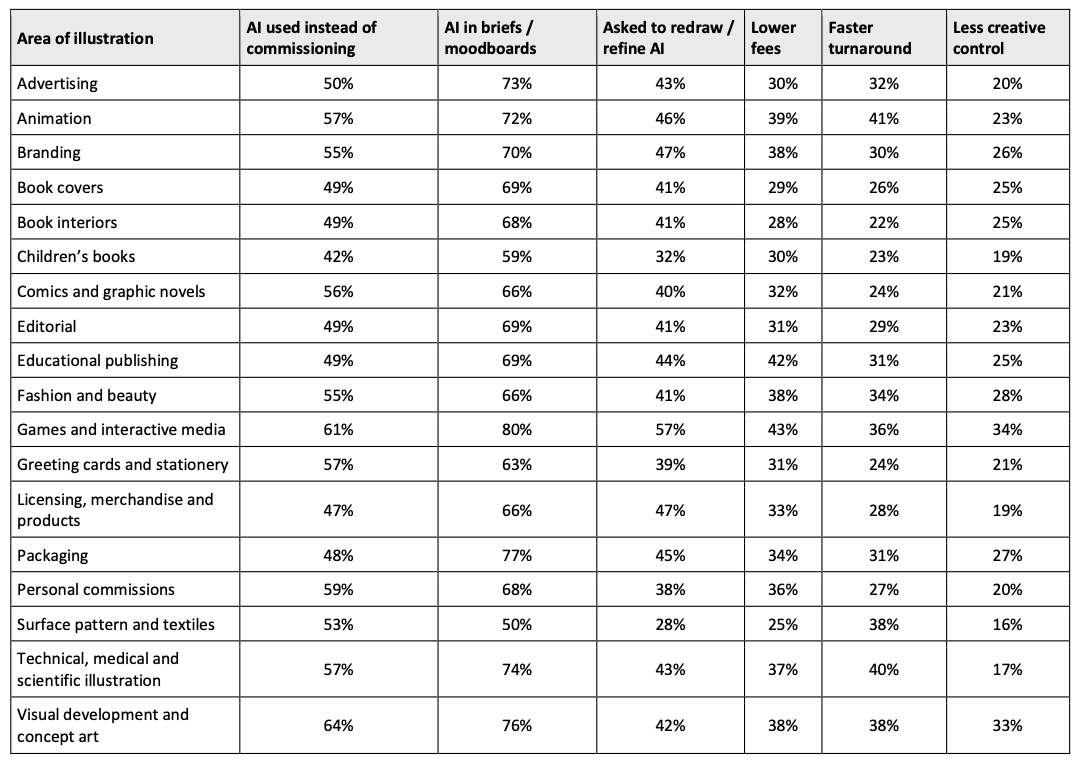
The AOI broke down responses across 18 areas of practice. Pressure is most visible in visual development and concept art, where 64 percent report clients using AI instead of commissioning – the highest figure of any field. In games and interactive media, 80 percent had encountered AI material in briefs and 57 percent had been asked to rework generated images. Games also shows the highest fee pressure (43 percent) and the greatest loss of creative control (34 percent). In animation, 41 percent report expectations of faster turnaround, another peak value.
In advertising, packaging and licensing, by contrast, AI shows up mainly in the brief rather than as an outright replacement. The gap is widest in packaging: 77 percent have seen AI material in briefs, while 48 percent have seen AI replace a commission.
Publishing: AI in the brief is already routine
For book and media publishing, the report paints a mixed picture. AI-generated material in briefs is similarly widespread across book covers (69 percent), book interiors (68 percent), educational publishing (69 percent) and editorial (69 percent). Educational publishing also stands out for fee pressure: 42 percent of illustrators working there report lower fee expectations, and 44 percent had been asked to rework AI images. Covers and interiors show less fee and deadline pressure, yet around four in ten respondents in each were asked to fix up generated images.
Children's books are the least affected field. Even so, 42 percent report clients using AI images instead of commissioning illustration, and 59 percent have seen AI material in briefs. The AOI explicitly warns against treating the field as “safe”.
Those who are already disadvantaged lose out more often
The impact is particularly hard on illustrators who consider themselves underrepresented or marginalised in the industry. In this group, 60 percent know they have lost work to AI, compared with 36 percent of other respondents. 29 percent of underrepresented respondents saw their illustration income fall by more than half, against 16 percent of others. 34 percent feel more severely affected by generative AI because of their background, style or subject matter, compared with 4 percent of other respondents. Among respondents with a disability, neurodivergence or a long-term health condition, 64 percent report lost work and 52 percent fee pressure.
The report also asks what happens to the first rung of the career ladder. A recent graduate said clients complain she is not as quick as ChatGPT. Yet early commissions are where emerging illustrators learn to interpret briefs, work with art directors, negotiate fees and build relationships. If that work disappears, the next generation loses the experience it needs.
Consent: yes, licensing: no
While reported lost work is rising, illustrators' expectations about their rights remain almost unchanged:
98 percent say AI companies should need permission before using copyright-protected illustration for training.
97 percent want transparency about training data.
97 percent support compensation where work has already been used without consent.
99 percent back labelling of AI-generated images.
Notably, the call for consent does not signal willingness to license: 86 percent would not allow their work to be licensed for AI training at all. For many, consent also means retaining the right to say no. Around nine in ten respondents are not confident that current UK law protects them against unauthorised training, copying or style imitation.
The AOI plans to use the data in its campaigning. In January 2026, together with ISM, AOP, the Society of Authors and Equity, it launched “Brave New World? Justice for creators in the age of GenAI”, which draws on evidence from more than 10,000 creators. Its CLEAR framework stands for Consent first, Licensing not scraping, Ethical use of training data, Accountability, and Remuneration and rights. The AOI also plans guidance for illustrators, for instance on AI clauses in contracts, and for commissioners, for instance on how to handle AI material in briefs.

AI as a tool rather than a source of ideas?
What these figures look like from the perspective of an individual illustrator is something Roland Vorlaufer described in his interview with dpr (in German). A graduate of Vienna's University of Applied Arts, he has designed more than 100 stamps for Austrian Post since 2017 and works for clients including Red Bull Media House's publishing arm. His own business has barely changed so far, he says, but he sees many colleagues suffering sharp drops in commissions – exactly what the AOI figures suggest.
Vorlaufer relies on classic, analogue illustration, which he says is still in demand when concepts such as “tradition, seriousness, trust” need to be conveyed visually. He finds it paradoxical that AI of all things has triggered a wave of opulent oil-painting imitations, which he reads as “a longing for classicism and substance that people think they can conjure up with AI”. He considers the technology backward-looking, because it is fed on the creative output of the past, and limited in content: “AI has no sense of humour.”
The contrast with the AOI findings is striking. There, illustrators complain of being reduced to mere execution. Vorlaufer sees the roles the other way round: “When it comes to illustration, AI seems perfect to me for the craft of producing images. No more, no less.” The idea behind the image, he argues, remains human. Whether clients will pay for that, he doubts: “All media that already paid unworthy fees will switch to AI-generated images.” The 31 percent of AOI respondents reporting lower fee expectations bear him out.
Vorlaufer subscribed to Midjourney out of curiosity – “fascinating and eerie at the same time” – but has hardly used it: “If you can draw, it feels somehow absurd to fall back on AI.” Should his clients switch, he intends to focus even more radically on exclusive, personal art such as portraits. That is no safe haven either: in the AOI survey, 59 percent of those working on personal commissions report clients choosing AI instead of an illustrator.
What lies behind an image must be made visible
The AOI closes its report with a thought Vorlaufer would likely share: illustration is not simply an output. Research, ideas, judgement and an individual creative voice have value of their own. Bringing illustrators in only to redraw loses precisely that part of the work.
The report “AI and the Future of Illustration” draws on 549 responses to the AOI's 2026 survey and 5,000 responses to the 2025 “AI and Copyright Consultation Survey for Illustrators”. The two are separate samples, not a panel. The year-on-year comparison of lost work uses the same core question. Respondents could select more than one area of practice and more than one form of underrepresentation.