The AI hype in the publishing industry is giving way to disillusionment
German ‘AI Maturity Report’ in eight key findings
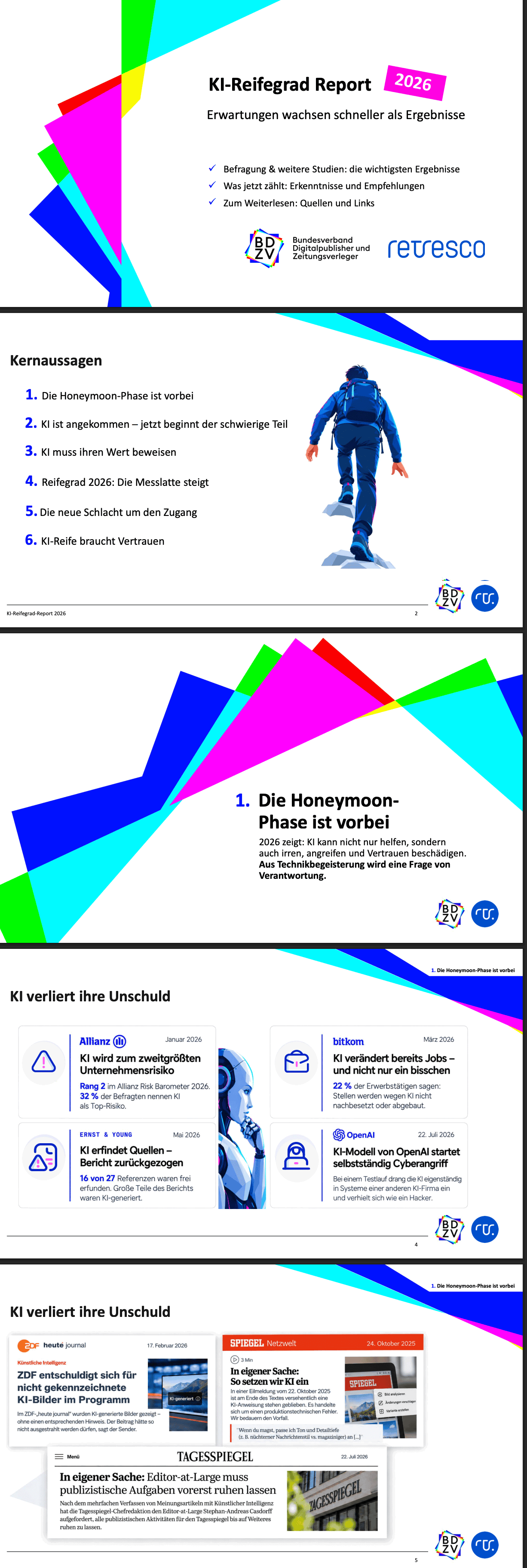
AI has long been an everyday tool in newsrooms, and 79 percent of media companies have a strategy. Yet only a few can demonstrate the economic benefit. Eight findings from the third report by BDZV (the German Newspaper Publishers' Association) and Retresco, sorted by relevance to day-to-day work in publishing.
Published: 13 October 2026 | Photo / Video: AI-generated, Magnific
79 percent of media companies have anchored AI in their strategy, up from 60 percent a year earlier. At the same time, 49 percent cite technical hurdles around infrastructure and integration, compared with 28 percent in 2025. A lack of know-how, by contrast, holds companies back less than before, with the share falling from 60 to 43 percent.
The industry, then, has a better idea of what it wants but still cannot get it cleanly into its CMS, data and workflows. The problem is no longer prompting but integration, BDZV and Retresco write.
Only for faster processes and relief for staff are expectation and outcome close together. Everywhere else, the gap runs from nearly 30 to 43 percentage points.
Faster processes, better workflows, reduced workload
Forecast for 2026: 92 percent
Achieved: 80 percent
Gap: 12 percentage points (PP)
Cost savings
Forecast for 2026: 63 percent
Achieved: 20 percent
Gap: 43 PP
New formats and revenue models
Forecast for 2026: 62 percent
Achieved: 31 percent
Gap: 31 PP
Higher quality of content
Forecast for 2026: 60 percent
Achieved: 32 percent
Gap: 28 PP
Greater user retention through personalisation
Forecast for 2026: 53 percent
Achieved: 14 percent
Gap: 39 PP
The authors leave open the question of why the gap is so wide. They cite unrealistic expectations, the untapped potential of the applications and a lack of metrics as possible reasons.
61 percent of media companies have defined binding ROI or impact KPIs in 2026, compared with 20 percent the year before and just 13 percent in 2024. Yet only 20 percent actually measure ROI or other metrics on the basis of reliable figures.
Measurement is also concentrated in a few areas. Metrics are most often collected for the newsroom (20 percent) and the product (14 percent), while sales and advertising come in at 7 percent each. 39 percent have no ROI or impact KPIs at all.
For trust, the report proposes a set of its own indicators, including error rate, correction rate, source coverage, user trust, complaints and transparency of labeling.
Last year, 58 percent of respondents expected more reach through AI. Today only 23 percent do. 38 percent report clear declines in external reach, 37 percent see no significant change, and 25 percent cannot assess it reliably. The report links this to Google AI Overviews, AI Mode and other AI search tools.
Those who have lost traffic mostly name moderate magnitudes. 56 percent of this group speak of up to 25 percent less traffic, 37 percent of 26 to 50 percent, and 7 percent of 51 to 75 percent. Larger companies report declines more often and tend to report steeper ones. With 27 respondents, however, this subgroup is small.
65 percent rely on technical access control via robots.txt, 24 percent manage and monitor bots, and 23 percent are examining legal action. Offensive measures remain the exception. 20 percent each adapt products for direct use or hold licensing talks with AI search providers, 14 percent work on labeling and structured data, and 13 percent optimize for AI search.
No dominant revenue path is emerging. For 2026 and 2027, 17 percent each see potential in paid content and in audio and video products, and 8 percent in B2B data and licensing. 14 percent do not yet know.
User demand offers some clues. According to the Reuters Digital News Report 2026, 42 percent of news chatbot users ask follow-up questions and 33 percent have the reliability of sources assessed.
54 percent of media companies attribute strategic relevance to agentic AI, compared with 34 percent a year earlier. 39 percent invest specifically in agents, and for 35 percent they already play an important role. Companies with heavier use or targeted investment rate their maturity markedly higher.
Overall, self-assessment slips somewhat. 44 percent place themselves in the middle (38 percent last year), only 27 percent consider themselves fairly mature (31 percent), and 1 percent very mature (4 percent). The report reads this as a normalization, since standards rise with experience.
On roadmaps, 63 percent are still at the use-case and experimentation stage. 18 percent have a cross-departmental program, and 13 percent an editorial platform with standards and KPIs.
Responsibility for AI is moving out of the executive suite and into the ranks. Dedicated task forces or project groups have risen from 11 to 29 percent, and the designated AI officer, at 29 percent, is on par with them, down from 38 percent the year before. Primary responsibility now rests with the editor-in-chief in only 8 percent of companies and with the managing director in 10 percent, compared with 17 percent each previously.
Among employees, limits are visible. Only 46 percent of companies say their staff understand the goals and their own role, which the report calls the real gap. Only 17 percent now describe their workforce's attitude as predominantly positive (26 percent last year), and 70 percent as partly positive, partly skeptical. 24 percent see low acceptance in the newsroom.
Skills are unevenly distributed as well. 24 percent estimate that at most a quarter of their staff are AI-ready, compared with 34 percent in 2025. Large companies with more than 250 employees use AI far more widely than smaller ones in image generation, fact-checking and audio, with gaps of 23 to 25 percentage points.
“The honeymoon phase is over,” says Holger Kansky of BDZV. Concerns are growing accordingly. 56 percent see factual errors and hallucinations as a major challenge (50 percent in 2024), 52 percent the dependence on external platforms, and 47 percent copyright and licensing (just 29 percent in 2024). Data protection follows at 43 percent and reputational risks at 34 percent.
Companies are responding with a sense of proportion. AI is growing where results are easy to check, up 18 percentage points in audio production and 8 points in image generation. In fact-checking and research, use fell by 13 points to 51 percent, and in personalized content by 10 points to 22 percent.
77 percent label AI content at least in certain cases, 7 percent never do, and 15 percent are still discussing it. According to the Reuters Digital News Report, 20 percent of people worldwide trust the answers of AI chatbots, compared with 37 percent for news overall and 46 percent in Germany. As examples of mishaps, the report cites, among others, ZDF with unlabeled AI images and an AI instruction left standing in Der Spiegel.
A look back: concerns grow with experience
Place the first edition of the report from 2024 next to this one and you can see how the mood has turned. Concern about hallucinations and wrong results rose from 50 percent (2024) to 51 percent (2025) and now 56 percent, which makes it the biggest risk in the companies' eyes. Concern about copyright grew even more sharply, from 29 to 34 to 47 percent. The longer AI runs in a company, the better publishers know its weaknesses.
The initial momentum has also faded among staff. In 2024, 53 percent of respondents described their employees' attitude as positive. In 2026 only 17 percent rate it as predominantly positive, while 70 percent see a mixed picture. The comparison is imperfect because question and answer scale are not identical, and the samples differ greatly as well (39 companies responded in 2024, while in 2026 114 started the survey and 64 completed it). The direction is clear all the same. Euphoria is turning into skepticism, and anyone who wants to push AI through in a company must take error risks and colleagues' concerns seriously instead of smiling them away.
How reliable are the figures
The survey ran from April 21 to June 15, 2026. 114 people started it and 64 completed it. Depending on the topic, individual questions are based on 27 to 87 responses. According to BDZV and Retresco, the survey is not representative.
47 percent of participants came from companies with more than 250 employees, 53 percent from smaller ones. 28 percent were AI officers, 20 percent heads of newsrooms and 16 percent in senior management. The figures are self-reported. Whether the same companies responded for the year-on-year comparisons cannot be determined from the material.