
A second set of eyes, powered by Gemini
Springer Nature and Google DeepMind are jointly developing an AI assistant for peer reviewers. A prototype is already being tested, and expert judgement is to remain with humans.
Published 5 November 2026 | Photo: AI-generated, Magnific
In BRIEF
Springer Nature and Google DeepMind are jointly developing a Gemini-based AI assistant to help reviewers assess manuscripts. A prototype is already being tested.
Expert judgement is to remain with humans. According to the partners, manuscripts and reviews do not leave the publisher's infrastructure.
AI reliably spots verifiable errors but struggles to judge novelty and significance. Research funders are already grappling with AI-generated reviews.
Rising submission numbers, overstretched reviewers, mounting time pressure: peer review has long been the bottleneck of scholarly publishing. Springer Nature is now turning to Google DeepMind for support. What the planned assistant is meant to do, what research says about AI in peer review, and why research funders are already struggling with the side effects.
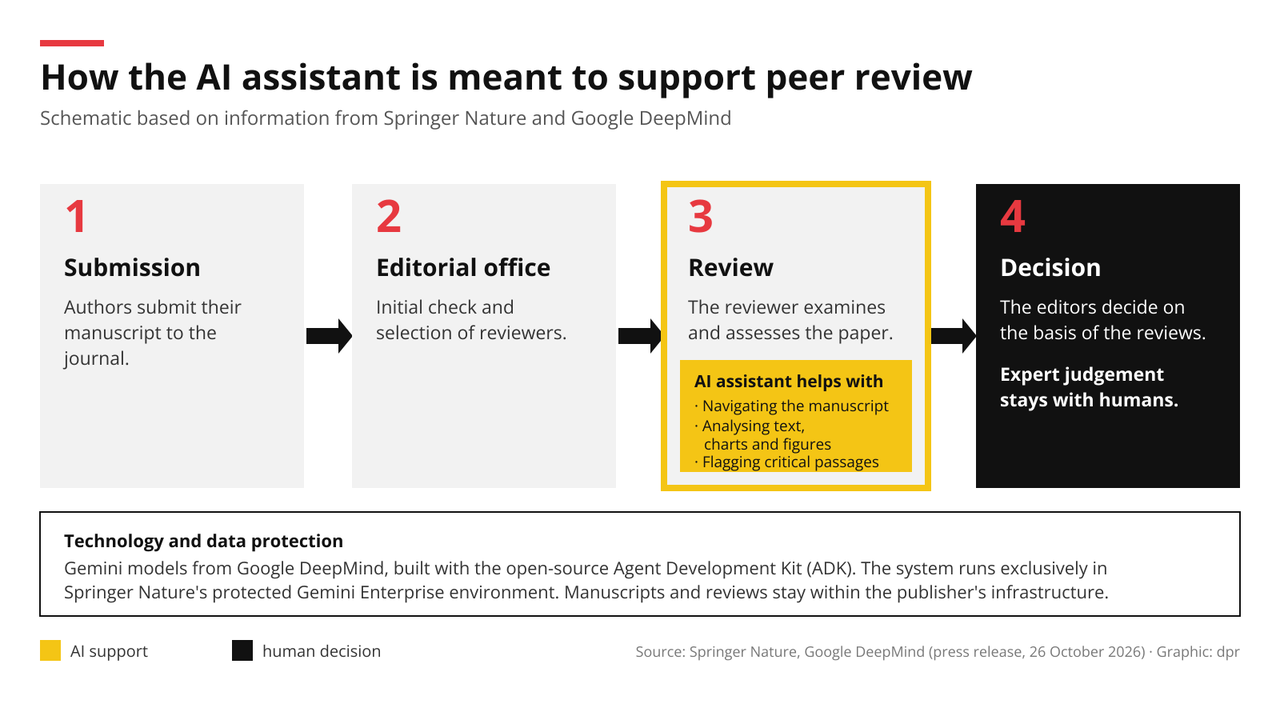
On 26 October, Springer Nature and Google DeepMind announced a research partnership. Together, the two companies plan to design an AI-powered assistant for peer review. It is intended to help researchers find their way around manuscripts, review papers more effectively and identify passages that merit closer scrutiny. Reviewers should then have more time for the questions that require subject expertise and scientific judgement.
On the technical side, the project relies on Google DeepMind's Gemini models. According to the press release, it builds on experience with agent-based research tools such as ScholarPeer and Deep Review. The assistant is designed to analyse large volumes of text, charts and figures. A prototype is already being tested. The aim, the partners say, is to rethink peer review as an interactive process.
Publisher emphasises human responsibility
Springer Nature explicitly puts reviewers at the centre. Saskia Steinacker, Chief Product Officer at Springer Nature, says the expertise and judgement of reviewers are fundamental to peer review. Given the growing volume and complexity of research, the publisher wants to explore how AI can support that expertise responsibly. For Springer Nature, she says, innovation and trust must go hand in hand: the company is testing what value AI can add while making clear where responsibility will continue to lie.
The publisher sums up its approach as “human first, AI second”. The project is part of wider efforts to make publishing smoother for authors and reviewers, including the publisher's own platform Snapp.
Manuscripts are meant to stay in-house
A sensitive issue for any AI application in peer review is the confidentiality of unpublished manuscripts. The partners address it through the architecture: the system is built on Google's open-source Agent Development Kit (ADK) and runs exclusively within Springer Nature's protected Gemini Enterprise environment. According to the companies, all content used for testing and development remains within the publisher's infrastructure.
Google DeepMind places the project in a wider context. Seshu Ajjarapu, Senior Director of Applied AI at Google DeepMind, says advancing scientific discovery requires peer review that is both rigorous and able to keep pace with research. The platform being developed together is meant to ease the burden of rising submission numbers while upholding the editorial standards of leading journals.
Strong on tables, weak on significance?
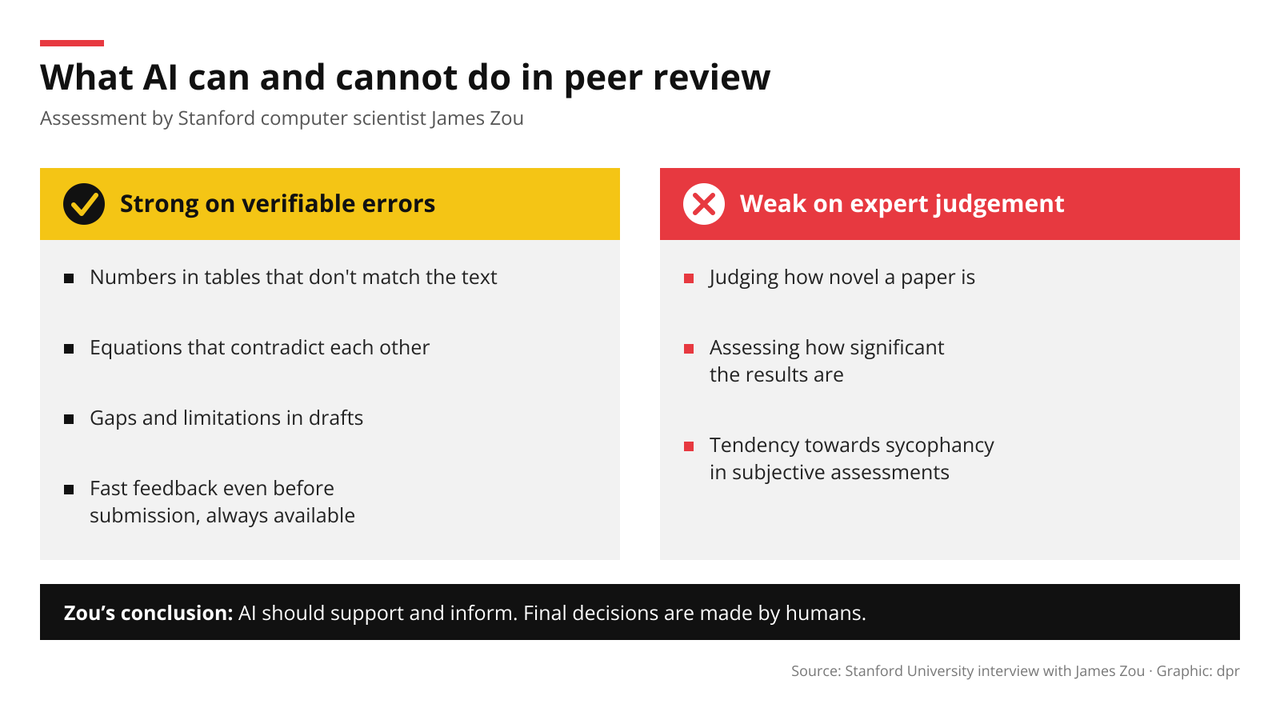
How much AI actually helps in peer review is the subject of intensive research. Stanford computer scientist James Zou and colleagues ran a large-scale randomised experiment around the ICLR conference, providing AI assistance on roughly 20,000 reviews. According to Zou, the AI feedback improved both the quality of the reviews and reviewers' engagement.
Zou nevertheless draws a clear line. “AI is strongest on objective, checkable inconsistencies and technical issues and weaker on subjective judgments about the novelty or significance of the research,” he said in an interview published by Stanford University (Further information). Typical examples are a number in a table that does not match the text, or two equations that contradict each other. Some of the AI's subjective assessments even border on sycophancy, Zou says. Final decisions must therefore be made by humans, and scientists must disclose how and where AI was involved in their research, writing and reviewing.
The level of interest is shown by Agents for Science, a conference Zou helped organise at which AI acted as both author and reviewer. It received more than 300 AI-led research submissions from 28 countries. Many conferences and journals are now exploring how language models can be used in the review process.
“People first, AI second”
SPRINGER NATURE’S MISSION STATEMENT
Funding organisations are grappling with AI assessments
Research funding shows that AI does not automatically make assessment easier. At the European University Association's Funding Forum in Brno in mid-October, Roisin Cheshire, head of individual-led research at Research Ireland, warned that there is not yet sufficient evidence that AI makes grant review easier overall. At the same time, reviews are coming in that are obviously AI-generated. “How do you police that?” Cheshire asked, as journalist Rachael Pells reported from the forum.
Pressure on the system is growing from both sides. According to data from the UK-based Research on Research Institute (RoRI), grant applications across twelve major European funders were on average 57 per cent higher in 2025 than in 2022, the year ChatGPT was launched. Jean-Pierre Vidal, director of the EIB Institute at the European Investment Bank, told the same event that while AI cannot be ignored, human assessors remain indispensable for the substantive evaluation of projects.
Many questions remain unanswered
The partnership between Springer Nature and Google DeepMind thus enters a paradoxical environment: the same technology that is meant to relieve reviewers is contributing to the flood of submissions that burdens them in the first place. Whether the assistant delivers on its promise depends on questions the press release leaves open. It is not yet clear which journals and disciplines the prototype is being tested in, how its benefits will be measured, whether authors will be told that AI was used on their manuscript, or when the tool will be rolled out more widely. The companies say they will publish further information once testing and development have progressed.
Newsletter
The latest from ai@media every week
New articles from all sections, delivered by email once a week.